



 polski
  Deutsch
  English

Flame-retardant underwear – mandatory or not? Check out the experts’ opinions.
 Flame-retardant underwear – mandatory or not?
From the point of view of ensuring effective protection of employees in explosion hazard zones, wearing flame-retardant underwear is definitely mandatory.
According to Polish regulations, there is no direct, unambiguous provision requiring the wearing of flame-retardant underwear under protective clothing, however, this obligation arises indirectly from general safety regulations, and all manufacturers of personal protective equipment should comply with the EU requirements of Regulation (EU) 2016/425 of the European Parliament and of the Council and the relevant standards.
They should carry out a risk assessment to identify all risks that apply to them. When designing and manufacturing protective clothing and drawing up instructions, the manufacturer shall anticipate not only the intended use, but also uses that can reasonably be foreseen.
In addition, in accordance with the Regulation of the Minister of Economy on minimum health and safety requirements related to the possibility of an explosive atmosphere occurring in the workplace (implementation of the ATEX Directive), the employer, in accordance with paragraph 4.4, is required to carry out a risk assessment and provide employees with appropriate protective clothing that protects against identified hazards (requirement in accordance with paragraph 10.3).
In accordance with paragraph 10.2 of the regulation, if the explosive atmosphere contains different types of flammable gases, vapors, mists, or dusts, protective measures corresponding to the greatest potential hazard must be applied without exception.

Dr. Przemysław Kędzierski from the Central Mining Institute – National Research Institute, who deals with, among other things, research into electrostatic properties, explains unequivocally:
“According to the Regulation of the Minister of Economy of July 8, 2010, on minimum requirements for occupational health and safety related to the possibility of an explosive atmosphere occurring in the workplace – paragraph 4, the employer shall carry out a comprehensive assessment of the risks associated with the possibility of an explosive atmosphere occurring in the workplace, known as a risk assessment. This paragraph states that the employer must take into account at least the extent of the anticipated effects of an explosion.
The explosion and its effects can be illustrated, for example, by observing the coal dust explosion carried out periodically at the Barbara Experimental Mine of the Central Mining Institute – National Research Institute, or even during the last edition of the DuPont™ Thermo-Man® Scientific and Technical Seminar.
An old Polish proverb says that prevention is better than cure. The fact is that the material and immaterial costs associated with burns suffered by an employee who was not wearing flame-retardant clothing or even flame-retardant underwear are incalculable.
Why is flame-retardant underwear a necessity, even though there is no direct requirement for it?
According to experts, best practices in occupational health and safety in this area point to three main factors that determine the need for flame-retardant underwear:
- Risk of material melting. Ordinary underwear can melt when exposed to high temperatures, electric arcs, or explosions. Melted material sticks to the skin, causing very serious and difficult to treat burns.
- Interaction of layers. The effectiveness of specialized protective clothing (e.g., antistatic, flame-retardant) is only guaranteed if all layers protecting the worker’s body, including underwear, are adapted to specific hazards. Flame-retardant underwear is the first protective barrier that does not melt, which is crucial for minimizing injuries (especially burns).
- Industry standards. Although not explicitly stated in the law, industry best practices and standards such as PN-EN ISO 11612 (clothing protecting against heat and flame) are interpreted by experts as requiring a complete protective system, including underwear.
From the point of view of ensuring effective protection of employees in explosion hazard zones, wearing flame-retardant underwear is therefore definitely mandatory.
“I consider the use of flame-retardant underwear to be a requirement, not an option. With over 20 years of experience as an expert and practitioner in the occupational health and safety industry, I know that this underwear provides a crucial first line of defense because, in the event of an accident, it will not melt like regular underwear. Thus, it protects the employee’s skin from very serious, difficult-to-treat burns caused by contact with an electric arc or high temperatures.”
Agnieszka Dembińska, experienced trainer, expert in the field of hazardous materials storage and management system auditor, including PN-EN ISO 9001, PN-EN ISO 14001, PN-ISO 45001, and ISO 50001.
Materials used to manufacture personal protective equipment and other components intended for short-term use in high-temperature environments, as well as those that may be exposed to hot splashes, such as molten materials, must have sufficient thermal insulation to prevent the transfer of most of the accumulated heat until the user leaves the hazardous area and removes the personal protective equipment.
Also, the amount of heat penetrating the personal protective equipment to the user must be sufficiently low so that under no circumstances will heat accumulate in the endangered part of the body above the level causing pain or health risk while wearing the equipment.
This is the reason for the legal obligation to provide additional protection in the form of flame-retardant underwear, thereby complying with the essential health and safety requirements set out in Annex II to Regulation (EU) 2016/425 of the European Parliament and of the Council.
Flame-retardant underwear – consequences of not wearing it
All layers of an employee’s clothing, including underwear worn under flame-retardant clothing, should meet the relevant protective requirements. The use of ordinary cotton or synthetic underwear, which does not have flame-retardant properties, can lead to serious skin injuries in case of contact with high temperatures, as the material may melt, ignite, or contribute to the spread of flames.
“The issue of selecting the right underwear for work in conditions where there is a risk of fire and heat exposure is one of our areas of scientific interest. As part of a research project carried out at the Central Institute for Labor Protection – National Research Institute, we conducted a series of laboratory tests on the protective properties of various materials and their combinations used in the production of protective clothing and underwear. Our research has shown that knitted fabrics that do not meet the requirements for flame resistance, when used in combination with fabrics with protective properties, pose a risk to the wearer when exposed to flames. This results in the knitted fabric catching fire and sometimes melting (in the case of synthetic fibers, i.e., polyester, polypropylene, polyamide), even when a flame-retardant outer fabric is used in the system.
Anna Dąbrowska, PhD, Eng.
Head of the Personal Protective Equipment Department at CIOP-PIB
Flame-retardant underwear – protection effectiveness confirmed by tests
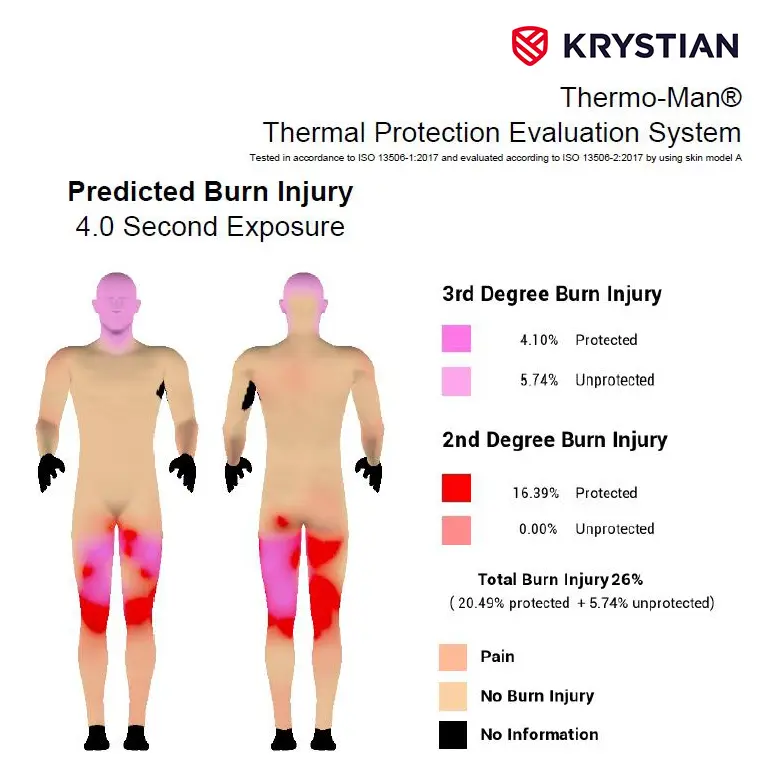
The tests carried out in the specialized Thermo-Man® laboratory best demonstrate the type and severity of injuries that an employee who has not worn this protective layer may suffer.
Thermo-Man® is recognized as one of the most advanced tools for assessing the effectiveness of protection provided by flame-retardant clothing against flames, and there are only four such laboratories in the world. This test is an advanced, standardized method of assessing the thermal resistance of protective clothing, using an anthropomorphic mannequin equipped with 122 temperature sensors, subjected to controlled exposure to intense flames.
The tests carried out clearly show that an additional protective layer in the form of flame-retardant underwear plays an important role in protecting the worker against second- and third-degree burns.
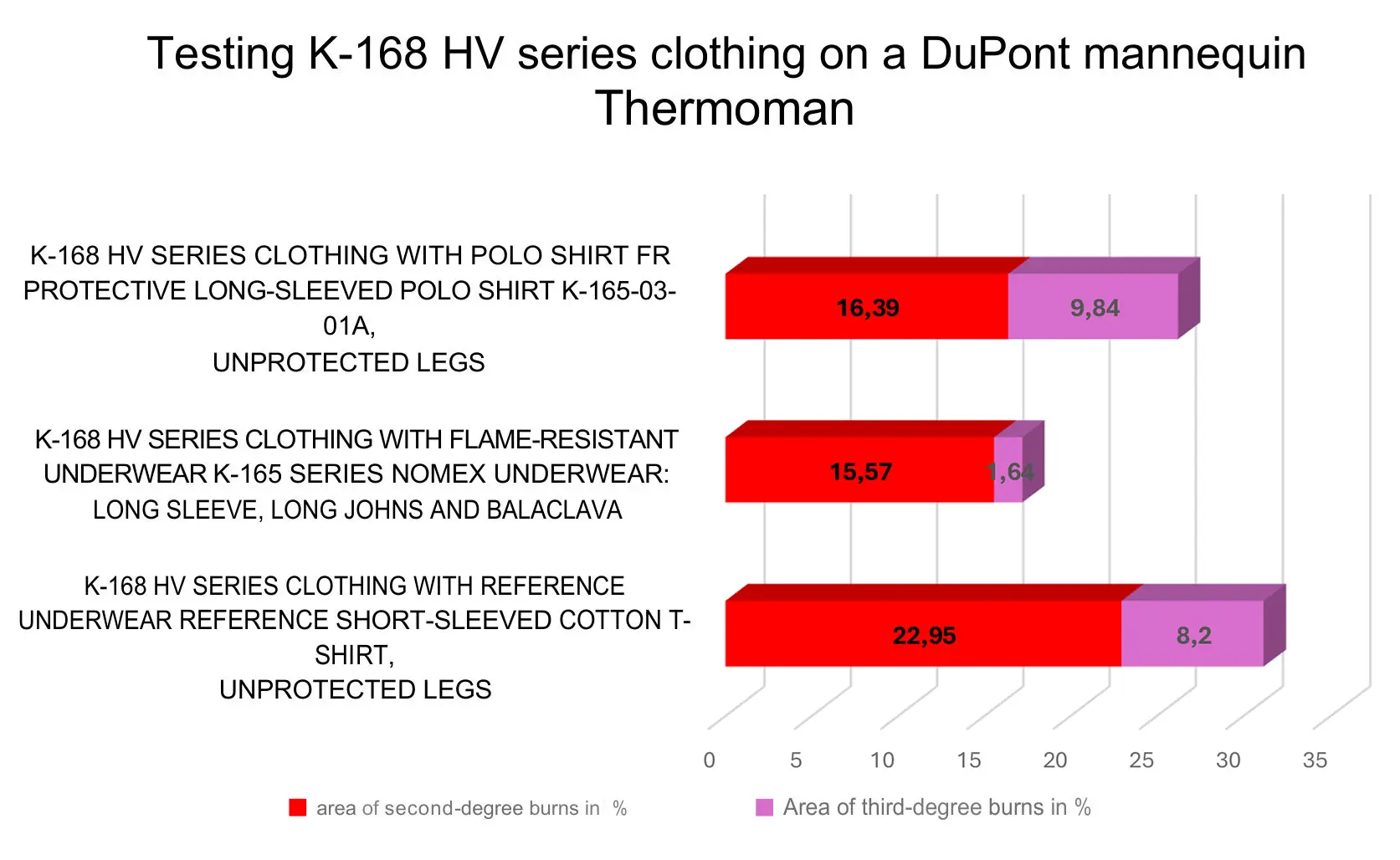
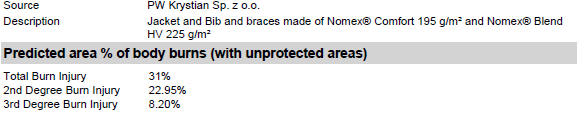
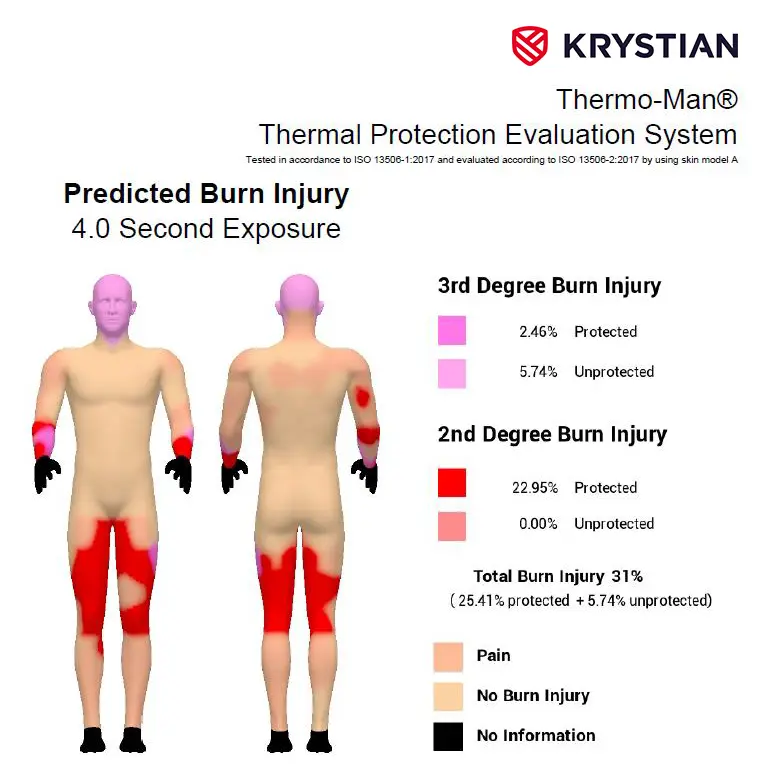
K-168 HV SERIES CLOTHING WITH REFERENCE UNDERWEAR – REFERENCE COTTON SHIRT WITH SHORT SLEEVES, UNPROTECTED LEGS
K-168 HV SERIES CLOTHING WITH FLAME-RESISTANT UNDERWEAR – K-165 SERIES NOMEX® UNDERWEAR: LONG SLEEVE, LONG JOHNS, AND BALACLAVA
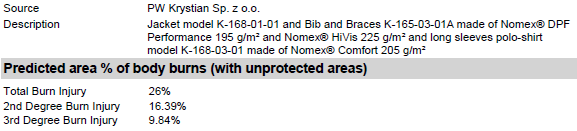
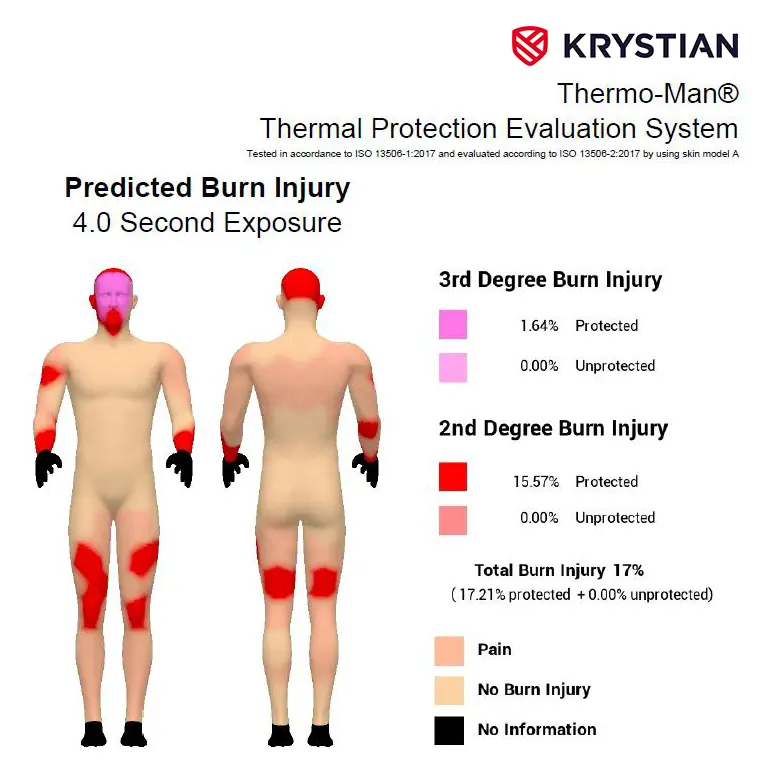
K-168 HV SERIES CLOTHING WITH K-165 SERIES POLO SHIRT – K-165-03-01A LONG-SLEEVED PROTECTIVE POLO SHIRT, LEGS UNPROTECTED
A chain is only as strong as its weakest link
Although Polish regulations do not contain a direct and unambiguous provision requiring the wearing of flame-retardant underwear, this obligation arises indirectly from general safety regulations, and the need to use it is determined by three main factors, identified as best practices in the occupational health and safety industry:
- Risk of material melting. When exposed to an electric arc, flame, or extreme temperatures, ordinary cotton or synthetic underwear acts like a ticking time bomb. It can melt, sticking to the skin and causing very serious, difficult-to-treat second- and third-degree burns. Flame-retardant underwear is the first barrier that does not melt, minimizing injury.
- Interaction of layers. Your expensive, specialized protective clothing (e.g., antistatic) is only a guarantee of safety if all layers, right down to the skin, are adapted to specific hazards. Flame-retardant underwear is the foundation of this system, providing the necessary thermal insulation. If the first barrier fails, the entire system is at risk.
- Industry standards. Best health and safety practices and international standards, such as PN-EN ISO 11612, are clearly interpreted by experts: you need a complete protective system, including underwear.
Don’t risk the health and lives of your employees by relying on half-measures. Protect yourself comprehensively today – starting with the key first layer of protection!
More about our technological solution for certified flame-retardant underwear
FAQ
However, Polish regulations do not contain a direct, unambiguous provision that would explicitly require the wearing of flame-retardant underwear under protective clothing. This obligation arises indirectly from general safety regulations.
The employer has a legal obligation to provide adequate protection, which stems from:
<ol>
<li>Regulations of the Minister of Economy (implementation of the ATEX Directive)</li>
<li>EU requirements: Manufacturers must comply with the EU requirements of Regulation (EU) 2016/425 of the European Parliament and of the Council.</li>
</ol>
<ul>
<li>Risk of material melting</li>
<li>Adhesion to skin</li>
<li>Inflammation and flame spread</li>
<li>Weakening of the protective system (interaction of layers)</li>
</ul>
<ol>
<li>Minimizing injuries: In the event of an accident, the underwear will not melt like regular underwear.</li>
<li>Protection against burns: Protects the employee’s skin from very serious, difficult-to-treat burns caused by contact with electric arcs or high temperatures.
<li>Reduction of burn severity: Studies have shown that an additional protective layer in the form of flame-retardant underwear plays an important role in protecting the worker from second- and third-degree burns.
<li>Support for the protective system: Flame-retardant underwear forms the foundation of a complete protective system, providing the necessary thermal insulation. </li>
<li>Regulatory compliance: Helps maintain compliance with the essential health and safety requirements set out in Regulation (EU) 2016/425 of the European Parliament and of the Council.
</ol>